New hardware is fun. Rewriting a working application to accommodate it is not. That trade shows up in almost every accelerator demo I have sat through: the board goes live, and quietly the app grows a special client library, then a special request shape, then a special set of apologies for whenever the board is having a bad day. If adding an accelerator means rewriting the app, the hardware lane has become an island.
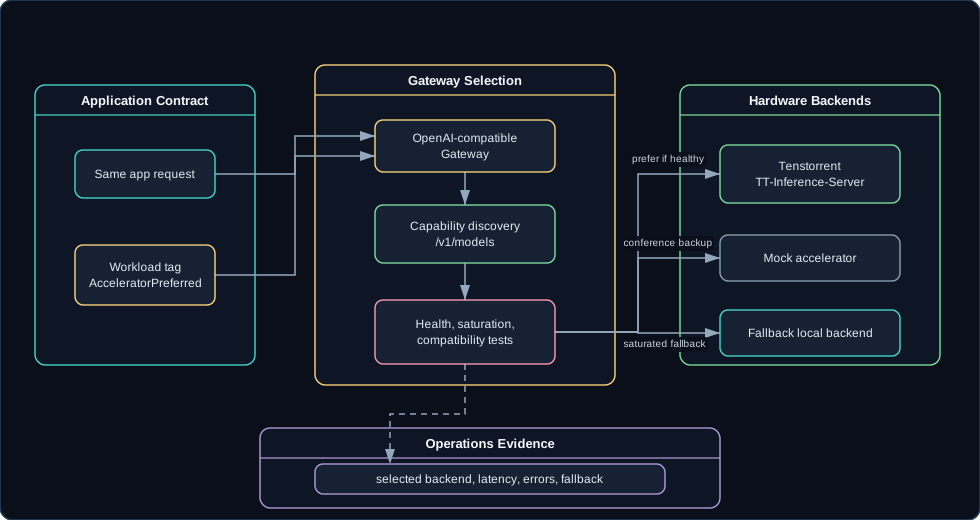
Demo 6 keeps the application completely unchanged. Tenstorrent - or a mock accelerator that behaves like one - registers as another backend behind the AI on the Edge Gateway, and the routing policy decides what that is worth.
How Hardware Becomes an Island
Accelerator demos tend to drift toward hardware-specific code paths:
- A different client library.
- A different request shape.
- A different health check.
- A different dashboard.
- A different fallback story.
Each step is defensible on its own during bring-up, and together they are bad for application architecture. The application should ask for a workload. The router should decide whether an accelerator is eligible, healthy, and preferred.
Nobody here is claiming one hardware path is always faster. The claim is narrower and more useful: specialized hardware can join the governed edge platform and stay part of it.
One More Backend in the Registry
 (opens in a new tab)
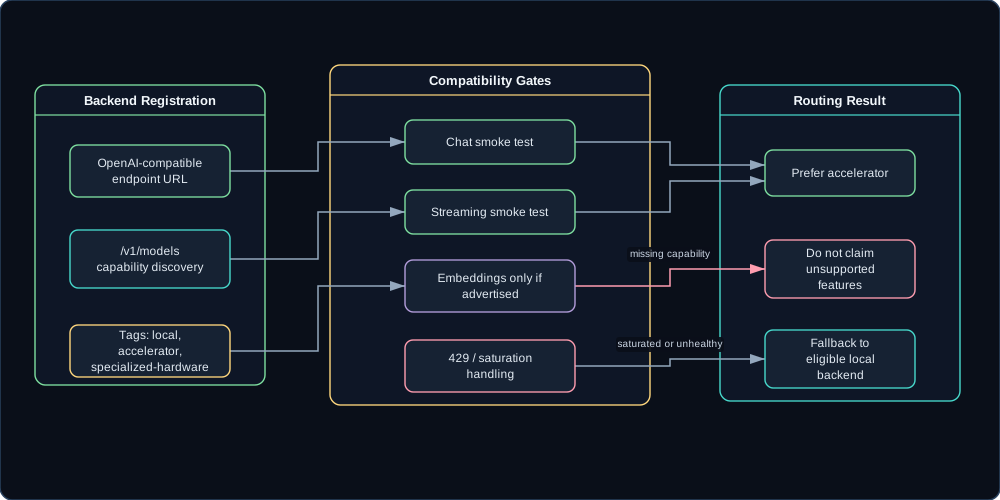
The whole trick is that the accelerator lane is just a backend registration, using the same registry schema as every other backend:
{
  "id": "tenstorrent-edge",
  "kind": "OpenAICompatible",
  "baseUrl": "http://tenstorrent-edge:8000/v1",
  "families": ["chat"],
  "models": ["accelerator-chat"],
  "location": "edge",
  "capabilities": ["chat", "streaming"],
  "tags": ["local", "accelerator", "specialized-hardware"],
  "priority": 5
}
 (opens in a new tab)
From there the gateway treats Tenstorrent like any other OpenAI-compatible backend until it has a reason not to:
- Discover models through
/v1/modelsor a configured model list. - Record capabilities explicitly.
- Test chat, streaming, and embeddings independently.
- Track latency, status codes, saturation, selected count, and fallback count.
- Expose compatibility failures in the route trace.
The routing policy is AcceleratorPreferred, not AcceleratorOnly. If the accelerator is healthy and supports the requested model family, it wins. If it is unhealthy or saturated, the router picks another eligible local backend, and the audience never has to think about it.
One status caveat I want on the record: as of August 2026, Tenstorrent’s documentation describes TT-Inference-Server for deploying LLM serving on its hardware, including container management, model downloads, serving configuration, and an OpenAI-compatible API endpoint. Model support still depends on the validated hardware and software combination, which is exactly why the gateway discovers and displays capability rather than assuming it.
What the Demo Has to Prove
The proof the audience needs is that no application code changes. Everything else is staging:
- Show the backend registry: Foundry Local, Azure Foundry, mock cloud, Tenstorrent, mock accelerator.
- Ask the same operational question used in Demo 1.
- Add workload metadata:
AcceleratorPreferred. - Show the router selects
tenstorrent-edgeormock-accelerator. - Stream the response through the same app and gateway.
- Show metrics and backend health.
- Mark the accelerator saturated.
- Ask again.
- Show fallback to another eligible local backend.
- Show the app request did not change.
Step ten is the entire point. Steps two through nine exist to make step ten believable.
I also avoid benchmark claims unless the evaluation harness produced them. The architecture claim here is about portability and governance. Vague performance wins are exactly what a skeptical room smells first.
What Is Actually Left to Build
Most of this lane is assembly work. The private cloud buildout already describes the Tenstorrent lab path and the mixed accelerator environment. The Demo 1 gateway already provides the abstraction that keeps the app unchanged, and the Demo 5 design supplies saturation and fallback controls. What remains is adapter hardening:
- Tenstorrent backend config profile.
- Capability discovery and display.
- Health check and timeout behavior.
- Compatibility tests for the supported API paths.
- Accelerator-preferred routing policy.
- Saturation fallback behavior.
- Optional hardware metrics later, starting with endpoint-level metrics now.
The mock accelerator is a requirement of the demo plan. Real hardware is valuable, and the session still has to work when the board is offline, in use by something else, or running a different model than the demo expects. A dependency I cannot reproduce on demand is a coin flip wearing a schedule.
Where Overpromising Starts
Overpromising hardware support is how this lane goes wrong. OpenAI-compatible does not mean feature-complete: chat, streaming, embeddings, tool calls, batch behavior, and error semantics all need separate smoke tests, because each one is its own little contract the hardware may or may not honor.
So the gateway displays capability and denial explicitly instead of discovering the gap mid-request:
{
  "backendId": "tenstorrent-edge",
  "eligible": false,
  "reason": "Backend does not advertise embeddings capability."
}
An honest “no” from the router beats a mystery timeout from the hardware every time.
Judging the Accelerator Lane
The lane works when a Tenstorrent endpoint or the mock accelerator registers as a backend like any other, the router prefers it for workloads tagged AcceleratorPreferred, and fallback happens on its own when the board is unhealthy or saturated. Metrics have to carry selected backend, latency, errors, and fallback count, since the only interesting question about an accelerator is how often the router actually chose it and what happened when it did not.
The criterion I watch is the one about the application: the app has to be byte-for-byte the same before and after the accelerator exists. The moment swapping a backend means touching application code again, this stopped being an architecture and became a science project. And no performance number appears anywhere unless the evaluation harness produced it, which is the same rule I would want applied to somebody else’s hardware post.
Related Posts
This post connects the Tenstorrent private cloud buildout to the AI on the Edge gateway. The hardware is part of the architecture, but not the whole architecture - that distinction is why the application survived this demo untouched.